Original Article
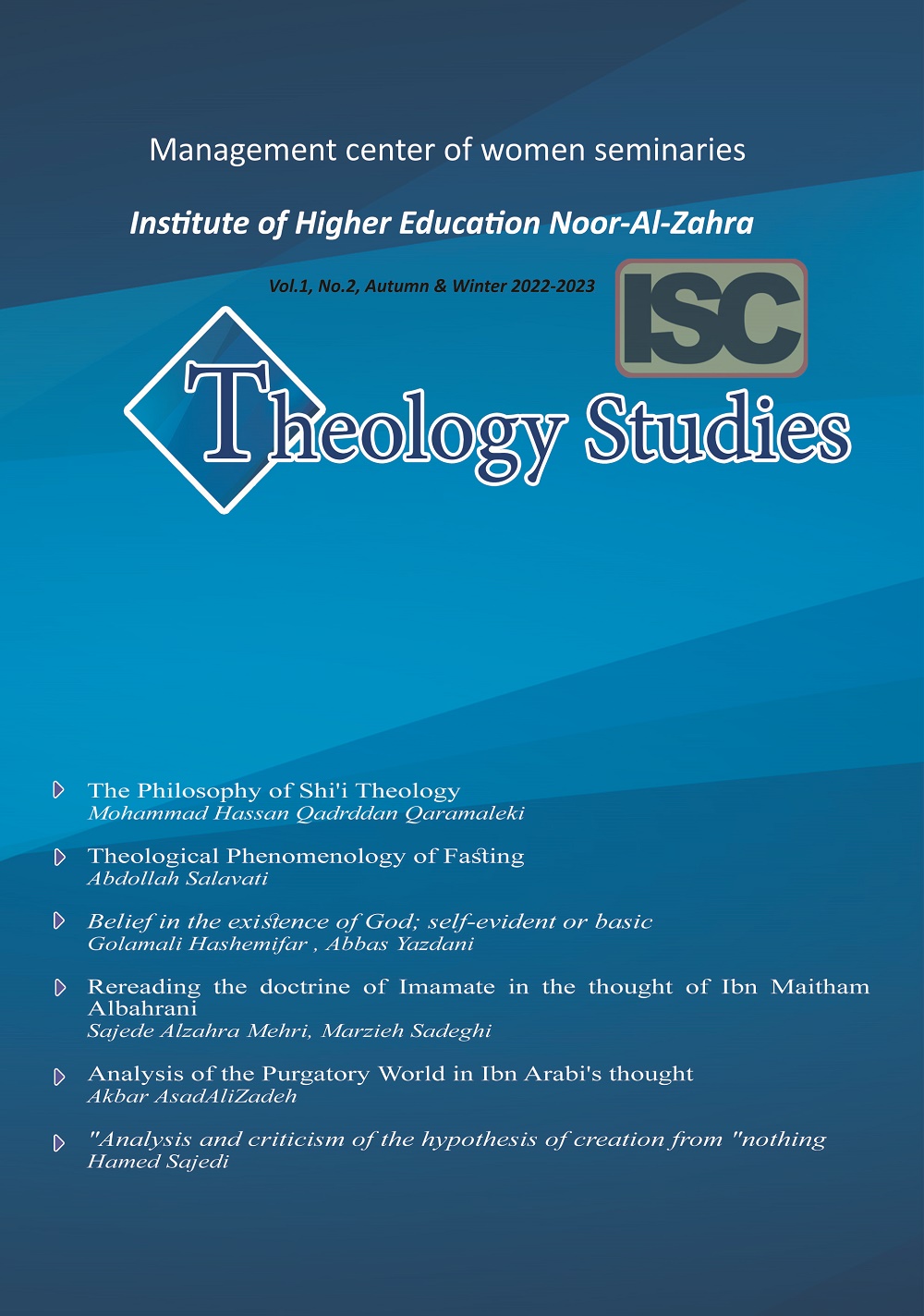
1. The Philosophy of Shi'i Theology

mohammad hasan gadrdan

Volume 1, Issue 2 , February 2023, Pages 7-34

http://dx.doi.org/10.22034/kalam.2023.279

Abstract
  This article has an external view of Islamic-Shia theology which theology and its issues are analyzed in general and from the perspective of an external judge. Shia theology is a science that explains religious doctrines, compiles and answers its doubts with its own sources (Qur'an, Prophetic and guarding ...  Read More

Original Article
2. Theological Phenomenology of Fasting

abdollah salavati

Volume 1, Issue 2 , February 2023, Pages 35-51

http://dx.doi.org/10.22034/kalam.2023.280

Abstract
  Phenomenology is a kind of return to the beginning and the source and an action in the direction of resuming the living relationship with reality. Also, the phenomenologist tries to establish a new, alive and active relationship with things with steps such as suspension and eidetic reduction and phenomenological ...  Read More

Original Article
3. Belief in the existence of God; self-evident or basic?

Golamali Hashemifar; abbas yazdani

Volume 1, Issue 2 , February 2023, Pages 53-76

http://dx.doi.org/10.22034/kalam.2023.281

Abstract
  Some Islamic thinkers have contended that the belief in the existence of God is self-evident by presenting arguments such as the argument of Fitrah, the truthful argument, and the argument of religious experience. The purpose of this research that has been done by theoretical-library and analytical-critical ...  Read More

Original Article
4. Rereading the doctrine of Imamate in the thought of Ibn Maitham Albahrani

sajede alzahra mehri; marzieh sadeghi

Volume 1, Issue 2 , February 2023, Pages 77-95

http://dx.doi.org/10.22034/kalam.2023.282

Abstract
  : The idea of ​​Imamate is the central point of Shia thought and many thinkers tried a lot to establish this doctrine in the structure of theology. In other words, the Shiite political system is formed with the Imam as its center. In the past eras, Shi'a political rival flow emerged on the axis of ...  Read More

Original Article
5. Analysis of the Purgatory World in Ibn Arabi's thought

akbar asadalizadeh

Volume 1, Issue 2 , February 2023, Pages 97-114

http://dx.doi.org/10.22034/kalam.2023.283

Abstract
  Purgatory world has been one of the fundamental religious teachings that has been debated and talked about a lot in different aspects of theological, philosophical and mystical points of view since long ago. Ibn Arabi divides Purgatory world into two realm; descending section (the distance between the ...  Read More

Original Article
6. Analysis and criticism of the hypothesis of creation from "nothing"

hamed sajedi

Volume 1, Issue 2 , February 2023, Pages 115-142

http://dx.doi.org/10.22034/kalam.2023.284

Abstract
  : Creation from nothing is a hypothesis suggested by some physicists such as Tryon and Vilenkin in response to why the cosmos exist. People like Hawking and Krauss claimed more clearly that this hypothesis will make us free from the hypothesis of god as a creator. Since This statement is an important ...  Read More

Original Article
7. Explanation of Intercession through Anthropological Foundations of Mulla Sadra

fatemeh babaee; sahar kavandi

Volume 1, Issue 2 , February 2023, Pages 145-168

http://dx.doi.org/10.22034/kalam.2023.417

Abstract
  Intercession is one of the significant subjects among Muslims, and diverse interpretations have been made by different sects due to the seemingly different verses mentioned in the Quran about this issue. Nevertheless, all sects of Islam have acknowledged it, they have had differences regarding its explanation ...  Read More

Original Article
8. Foundations of Moral Theology in the Doctrinal Thought of Sheikh Tusi

hosein zare; saeid kazemi

Volume 1, Issue 2 , February 2023

http://dx.doi.org/10.22034/kalam.2023.418

Abstract
  Ethics is formed from several theoretical foundations, whose role is essential in formulating ethical guidelines. The present research aims to shed light on the foundations of the theology of ethics by examining the theological thoughts of Sheikh Tusi, who is considered one of the great scholars of the ...  Read More

Original Article
9. Analytical-Critical Reading of the Definition of Imamate from the Perspective of the Imamiyyah

hasan akhond gorgi; sajjad azarian; Ali Azarian

Volume 1, Issue 2 , February 2023

http://dx.doi.org/10.22034/kalam.2023.419

Abstract
  Imamate is one of the significant topics in the circle of Islamic thinking and according to the main Imamiyyah, it is one of the principles of religion in a way that the eternal happiness of man is tied to it. The topics of imamate can be discussed in three areas: "literal imamate", "legislative imamate" ...  Read More

Original Article
10. Reaching Salvation by Confidence on Bhagavad Gita (भगवद्गीता) and the Holy Quran

noormohammad ansari
Volume 1, Issue 2 , February 2023

http://dx.doi.org/10.22034/kalam.2023.420

Abstract
  The salvation of man, which is part of the important theological concerns in various religions and their holy texts, is also one of the issues and reflections of Hinduism and Islam, as the concepts, methods, and practices of reaching it are evident in the Bhagavad Gita and the Holy Quran. Bhagavad Gita, ...  Read More

Original Article
11. Faith and the Realm of its Truth

Hojat lotfi garamalki

Volume 1, Issue 2 , February 2023

http://dx.doi.org/10.22034/kalam.2023.421

Abstract
  Understanding the concept of faith and its association with verbal, actual and practical manifestations and the truth and falsity of faith in a belief that is devoid of these external manifestations is a problem that has long been the subject of controversy among Islamic scholars. The present research ...  Read More

Original Article
12. Comparative Reading on Suffering in Islam and Buddhism

esmaeil afkhami

Volume 1, Issue 2 , February 2023

http://dx.doi.org/10.22034/kalam.2023.422

Abstract
  The issue of human suffering has been discussed in different religions and schools. By comparing Buddhism and Islam, this research concluded that liberation from suffering is the main goal of Buddhism. The answer given by the Buddha to the four questions of the definition of suffering, its origin, what ...  Read More